Read all about it!

August 17, 2026

BnD-BookClub

A bookshelf doesn't sound like a competitive advantage. But in a space built for four or five people, a well-loved paperback with a handwritten note inside it does something no ergonomic chair can: it makes a stranger feel less like one.

The world has enough coworking spaces

The first wave of digital nomad culture gave us high-density hubs, neon signs, and the vague promise of community that turned out to mean sitting near other people with laptops. Most mid-career professionals have been through at least one of those spaces and left feeling lonelier than when they arrived.

What actually works — what makes a place feel worth being in — is almost never the infrastructure. It's the small rituals that accumulate into a sense of belonging. The coffee that's always there. The dinner that happens without anyone organising it. The book someone left on the shelf with a note inside.
The bookshelf

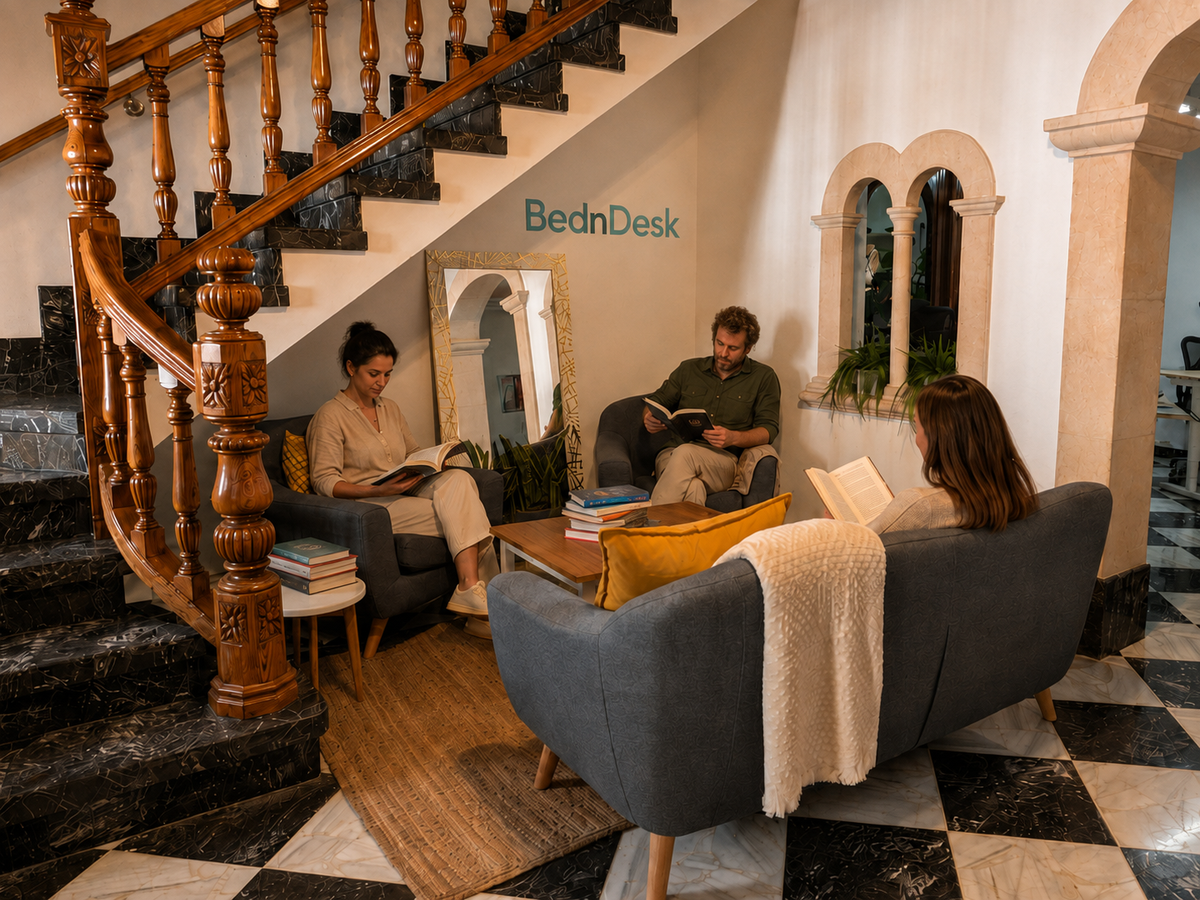
BednDesk has a Take One. Leave One. bookshelf. It's an adaptation of the Little Free Library model — a global movement that's facilitated the exchange of over 300 million books across 150,000 locations worldwide — but in a space this small, it operates differently.

When there are only four or five people in a building, the book someone chose to bring and then chose to leave behind becomes a small act of introduction. The dog-eared pages tell you something. The handwritten note on the inside cover tells you more. A founder from Berlin, a writer from Seoul, a designer from Buenos Aires — connected not by a mixer or a networking event, but by the same copy of a book that's travelled further than most people do in a year.

"It's a living record of everyone who passed through — which, in a place this intimate, is worth more than any amount of LinkedIn connections."

The ritual matters precisely because it asks nothing of you. No screen, no performance, no obligation to be interesting. You pick up a book, or you leave one. That's the whole interaction. In a working day full of high-stakes outputs and deliberate communication, that kind of frictionless exchange is rarer than it should be.

Why small rituals do heavy lifting

The professional case for intentional co-living isn't complicated: isolation is expensive. Not financially — cognitively and emotionally. Working alone in a beautiful place is still working alone, and the cumulative weight of that, over weeks or months, is one of the things that makes remote work genuinely hard.

The antidote isn't forced socialising. It's low-stakes shared moments — the kind that happen naturally in a space with five people, a common area, and a shelf of well-travelled books. You don't schedule them. They just occur.

The capacity cap at BednDesk — four to five guests — isn't a limitation. It's the whole point. At that scale, you know who you're sharing space with. Strangers become temporary neighbours by the second evening. That's a fundamentally different experience from a thirty-person hostel, and a fundamentally different one from a hotel room where you're entirely on your own.

The rest of it

The infrastructure exists and it's good — fibre internet, ergonomic setups, dedicated monitors, private meeting rooms for calls that need privacy. One minute from the beach on foot. Female-owned, LGBTQ-managed, deliberately warm in atmosphere rather than just in aesthetic.

But the thing people tend to mention when they leave is the bookshelf. Or more specifically, the note someone left in a book three months ago that turned out to be exactly what they needed to read that week.

That's not something you can put in a spec sheet. It's just what happens when a space is small enough, and intentional enough, for it to.

What would you leave?

If you stayed at BednDesk and left one book on that shelf — the one you'd want a stranger to find — what would it be? It's a more revealing question than most interview questions, and considerably more fun to answer.

Details on availability at the link. The shelf has space.